Please join us for our Works in Progress events this semester. Some papers are pre-circulated; please note the descriptions associated with each event.
Winter 2020 Schedule
Monday February 10, 2020 at 12:15, Elrod 345
“Angry Old Men and Civic Identity”
Robin Leblanc (Politics, W&L)
Following World War II, under its democratically elected Communist leadership, Bologna, Italy developed into the wealthy, famously progressive city that Robert Putnam, et. al. used as an example of a thriving civil society in Making Democracy Work. In the parliamentary elections of 2018, however, elderly members of the Arci Benassi, an antifascist social center at the heart of Bologna’s progressive culture, confessed in a television interview to voting for the populist Lega Party. This confession sparked a public reckoning with shifts in Bologna’s community values, topped off by an open-mike discussion at the Benassi center involving community leaders from representatives of immigrant residents to the city’s administrator of “civic imagination.” The event exposed tensions visible in many places across the city. Paradoxically, despite the angry divisions between progressive elites and populists, however, their conflict is driven by a shared refusal to imagine a desirable civic community that is not dependent upon persistent economic growth. Both groups also overlook successes in marginal communities such as precariat youth. Yet, very slow or negative growth is the future of many democracies, and a refusal to imagine communities that can thrive within it is dangerous. My analysis draws on 18 months of ethnographic fieldwork conducted between November 2012 and August 2019 among diverse community stakeholders, including leaders of neighborhood associations, urban planners, elected officials, real estate agents, advocates for the homeless, and members of anarchic youth collectives, among others.
Please RSVP to Prof. Melissa Vise (mvise@wlu.edu) for a copy of Prof. LeBlanc’s paper and to provide an accurate head count for catering (preferably by Thursday February 6).
Monday March 9, 2020 at 12:15, Elrod 345
Roman Satire and Indigenous Italian Comedy: Unmasking a (Greek) Genre
Caleb Dance (Classics, W&L)
Aristotle offers several accounts of the origins of comedy, yet all of them share geographical and linguistic (κωμῳδία = kōmōidia) links to Greece. But what if laugh-seeking performances developed elsewhere in the Mediterranean? Horace, a Roman poet writing in the 1st c. BCE, explicitly depicts his Satires as a continuation of Greek comic traditions, but he also uses genre-specific terminology in his later poetry to establish (retroactively) a connection between his satirical poetry and something akin to an indigenous Italian “comic” tradition. Dance argues that Horace’s dual alignment with Greek and Italian traditions enables the Roman poet to reframe his earlier satirical project in distinctly Roman terms: comedy on the page rather than the stage.
Please RSVP to Kara Hemphill (hemphillk@wlu.edu) in order to provide an accurate head count for catering (preferably by Thursday March 5).
Monday March 30, 2020 at 12:15, Elrod 345
Florence As It Was: The Digital Reconstruction of a Medieval City
George Bent (Art History, W&L)
This paper reviews the progress of the digital humanities project entitled, “Florence As It Was,” which combines three-dimensional models of buildings, digitized documents, photogrammetric models of art works, translations of early modern descriptions, and original interpretative essays in an academic, not-for-profit, web-based platform that aims to recreate the Tuscan city as it appeared in the year 1500.
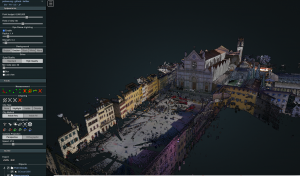
The city of Florence grew by the banks of the Arno River over the course of two millennia. At first a small ancient village, the town was reconfigured by Roman urban designers in the familiar grid pattern that marked most communities under their domain. That central core represented the city center until the late Middle Ages, when two new sets of walls rose up in the thirteenth century to gird its physical contours. Buffeted by an unusual entrepreneurial spirit, the city’s prosperity helped transform the urban environment into a vibrant cultural, spiritual, and social center, marked by abundant architectural enterprises that transformed it into one of Europe’s most important and desirable destinations. For centuries, we have depended on our collective imaginations to recreate that environment, that world.
Technological advances have mitigated such dependence. Thanks to collaborations with computer scientists, professional game designers, and experimental entrepreneurs, we have at our fingertips the capacity to recreate the physical environment of the old city of Florence at a time when its residents bought their food and clothes at outdoor markets, attended church daily, and repeatedly faced down threats of famine, disease, and warfare. “Florence As It Was” has as its mission the gradual reconstruction of this major cultural center, one structure at a time, city block by city block.
This presentation will highlight recent developments and models created in tandem with David Pfaff, Director of W&L’s IQ Center, and the five students who currently form the student research group of Florence As it Was.
Please RSVP to Kara Hemphill (hemphillk@wlu.edu) in order to provide an accurate head count for catering (preferably by Thursday March 26).